I recently bought a small bronze sculpture of a guy riding the back of a crocodile, mostly an impulse purchase. The vendor gave me a small wooden hippopotamus as a gift.
In Bambara, a "mali" is a hippo, and a "bama" is a crocodile. "Ko" means 'back', as in Bamako = the crocodile's back.
Today was a good day. Or rather, yesterday was, but I'm writing about it today. Before continuing you can find my celebratory Wassoulou music by following the link to Tata Diakité's magic.
AND Jacki Zehner listed Tostan as her #1 organization to support.
AND I found this amazing paper supporting the role film can play in improving development outcomes. A group worked in Ethiopia to study behavior change in poor communities with low economic expectations for the future, even in the face of investment opportunities that could provide high returns if they were to invest. The study looked broadly at behavior change, the formation of aspirations and other "future-oriented behavior". The method they used was film.
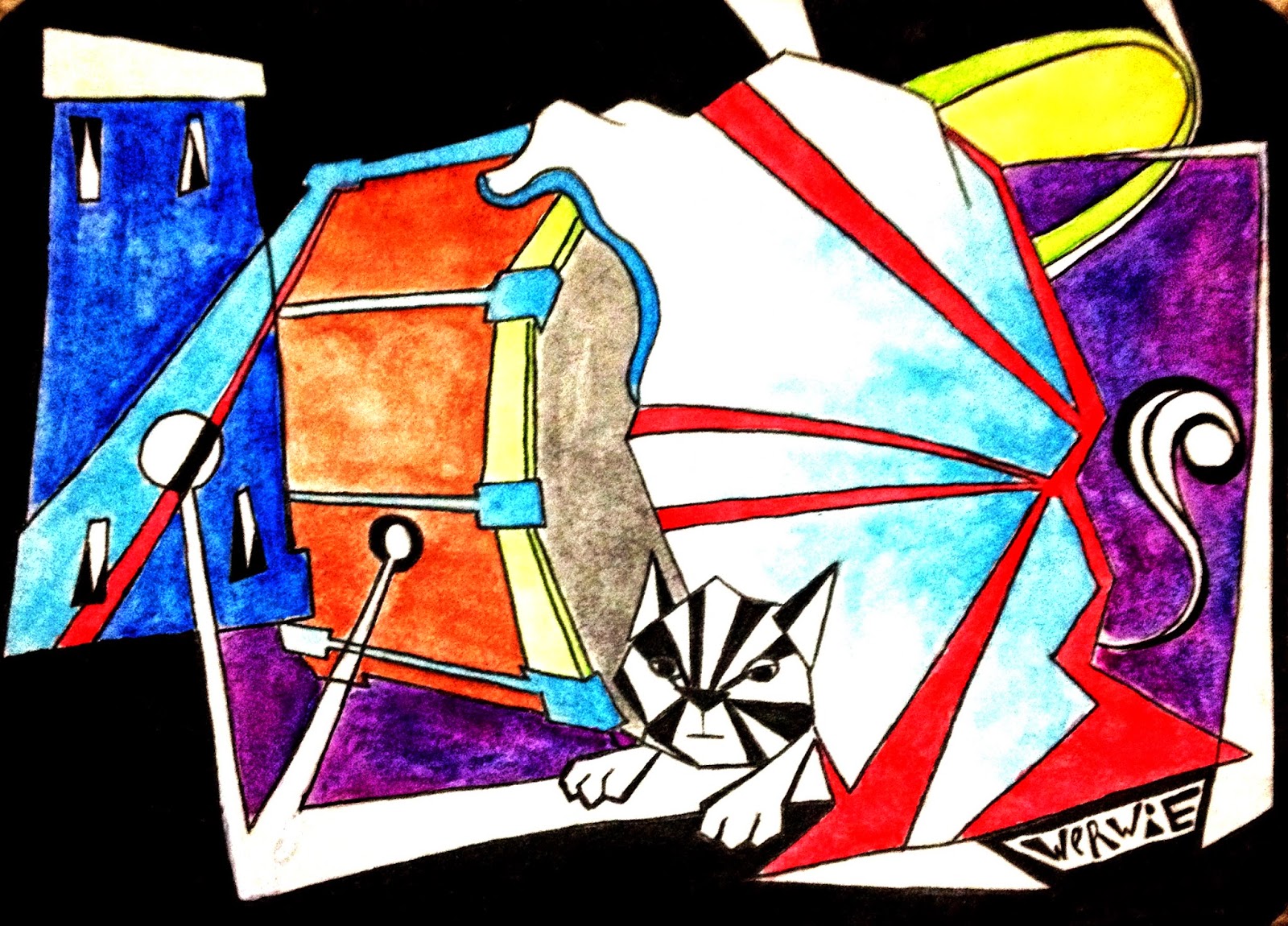
(random once-lost-now-found drawing #2):
The Experimental design:
1) Experimental group: a cohort was randomly invited to watch documentaries about people from similar communities who had succeeded in agriculture or small business without the help from NGOs or the government.
2) Placebo group: a second cohort watched Ethiopian "entertainment videos", such as traditional song and dance.
3) Control: a third cohort was simply monitored.
A survey was administered before treatment with the video, asking a range of questions designed to get a sense of participant's "future-oriented behavior" in regards to their willingness to invest and save financially, and to study the limited scope of aspirations and expectations in poor settings, as well as how those attitudes and behaviors could change over time when provided with a "role model" through the videos, which depict similar-but-different people achieving greater success through goal-setting. The survey was administered again 6 months after the treatment to assess the change.
Results: aspirations had improved among the experimental group, but not the placebo or control group. They found evidence of effects on savings and credit behavior, school enrollment for kids, and greater investment in kid's education. There were also what they call "peer-related effects", wherein people from the experimental group shared what they learned with their close friends. This resulted in further spending on education and induced more work and less leisure. These "peer-related effects" remind me of Tostan's model of "organized diffusion".
Conclusion (for me, at least, since the analysis they draw from the economic statistics is a bit over my head): showing a series of short documentary films that depict similar-but-different behavior can induce actual behavior change, which supports further research and implementation of film media interventions in health and development. I am, however, interested to know more about the investment in education. Was the follow-up survey administered as an academic school-year was starting? Why did people choose to start spending on education, instead of investing in a small income-generating activity like soap making, for example. Perhaps because an investment in education will provide long-term return, which highlights one of the goals of the study (changing aspirations, expectations, and "future oriented behaviors"). Regardless, six months seems like a short time to measure full behavior change. I wonder what the effects would be if they administered the survey in 6 years. Maybe for that time frame, multiple viewings of the films would be beneficial, or viewings plus workshops, or new documentaries produced...
This post starts with something new, and ends with something old.
Today marks the debut of 16 Days of Activism Against Gender Based Violence, with November 25th being the International Day For the Elimination of Violence Against Women, and December 10th being Human Rights Day. In honor of today, the 15 that follow, and so on into the future, I made a short film that celebrate's the work of Tostan's partner communities to protect human rights for everyone in their communities, and specifically for women and girls. You can find another post I wrote about the breadth of Tostan's work in West Africa here. Or read our 2013 Annual Report (which I also designed with Alisa Hamilton).
Some of the footage seen in this film was shot in the Kaolack and Kolda regions of Senegal. While in Kolda I was able to meet with community members and interview doctors and other health workers regarding long-term physical and emotional effects of obstetric fistula. I'm hoping that footage will be applied to another future project. Other footage comes from events before my time, where Tostan partner communities publicly pledge to abandon harmful practices in their communities.
Making this video was quite the learning experience. My background is in fruit fly biology, and vaccine development and public health education in Mali in 2008. Recently I've been pursuing a MFA in animation in order to use film and art as tools for targeted public health education interventions. There is quite a bit of research emerging as to the effectiveness of using film and other visual or performance arts to encourage behavior change in regards to overcoming things as diverse as poor agricultural yield in India to abandoning harmful social practices.
I recently resubmitted an application to Fulbright for funding to pursue this project. Last year when I applied, about 30 people submitted applications for Senegal specifically and only 2 awards were given out. So even in the best case scenario, my chances are limited. My advantage this year is that my project is significantly more focused and I'm working with the organization in the host country to which I'm applying.
I can confidently estimate that a budget of about $12,000-$15,000 could cover a year of dedicated work that would produce a short film intended specifically for local communities, and one that has tremendous potential to aid Tostan's (and Orchid Project, the Government of Senegal's, Girl's Not Brides and a number of other local individuals' and organization's) ongoing efforts to achieve total abandonment of female genital cutting and child/forced marriage.That budget could cover housing, food, travel, translators and other miscellaneous costs. If anyone is interested in learning more about my proposal or supporting my proposal, please leave a comment or send an email to wassoulou (at) gmail (dot) com.
Anyways, although I've been studying film, actually making one is a whole different beast...and the animation in this one is pretty limited. I'm pleased with all the flying text in the beginning, as overdone as it may be (thanks to a little self-education via endless AfterEffects tutorials). Side note: check these guys out. They have an office in Dakar and specifically use digital media like film and radio for health education efforts. They have offered technical support to me if I ever get my project funded...
Tostan originally intended the video to be for International Day of the Girl, in October, but the deadline was a bit too tight. I finished the entire film within 2 weeks but we didn't end up using it then. I was somewhat upset (naturally), or just sleep deprived (also naturally), but in retrospect we then had the opportunity to make edits and smooth some things out, and I think the video is much stronger because of it. One of my favorite parts of the whole process was engineering the sound (as limited as it is). Any guesses on who/where the music is from? If anyone who used to follow this blog when I fairly regularly posted Malian pop cassettes is still following, you might know. But for those of you who didn't, I reposted a post from sometime in 2010 to explain. The opening 6 seconds of the video above samples a bit from Bintou Sidibe (read below and click here to download her amazing tape). The rest of the video samples a short loop from Kokanko Sata.
Thanks for watching. Take some time to explore the hyperlinks in the text. Continue below for a repost from long ago:
In place of an image of the Bintou cassette, which I don't have, is a picture my friend drew in one of my notebooks that I rediscovered the other day. Thanks Nicole!
Voici another wassoulou treasure. My brief searches for extra information on Bintou Sidibe were rather fruitless (although this was cool). Bintou is of the old school of wassoulou women, among Coumba Sidibe, Kagbe Sidibe, and early Oumou Sangare. One brief conversation with friends in Yanfolila at the time, recounted a story where Bintou and Oumou recorded their cassettes at roughly the same period in the late 80's, and essentially raced to get them on the market. As I was told, Oumou's cassette got there first and blew up (perhaps for obvious reasons when you listen to both side by side), while Bintou remained locally famous, but not internationally so.
I don't have a version of Oumou's "Moussolou" cassette up to download, nor have I come across one in the vast internet ocean. And the quality of the youtube links that follow aren't great...nevertheless, listen to the similarities between Bintou's track Nene and Oumou's Diaraby Nene. And then listen to the nearly identical opening to Bintou's Neye Dounanye and Oumou'sDjama Kaissoumou. It wouldn't surprise me if they had a lot of overlap between studio musicians, which may have fed-back between the artists' sessions. (That might be a question Ngoniba can answer(?))
Oumou's versions, and her cassette overall, seem tailored to a broader audience, more tightly arranged, quicker and less exploratory. Bintou's on the other hand are long-form and embody the impovisational prowess for which local Mande music is known.
In general I think I prefer the long-form and extended instrumental parts in Bintou's tape. The relaxed tempo of all the music is quite pretty and the small ensemble allows the intricate and rhythmic playing of each instrument to blend very well; nothing is muddled (wait for Vol. 2, full of synthesizers and drum machine). Oumou's production incorporates modern drums (mostly just a hi-hat), a violin instead of soku, and pop arrangements. Diaraby Nene might be one of my all-time favorite wassoulou songs out there (especially the remastered 2003 version where you can clearly hear the kamelen'goni).
This first week in Dakar has been a whirlwind orientation about all of Tostan's work. I thought I knew what type of work they did (abandonment of Female Genital Cutting, (FGC)), but I quickly discovered that is only one small part of it. Tostan is easily pigeonholed as having this single issue focus (because they are extraordinarily successful at it), when in reality their success in changing the cultural psychology surrounding this social norm, towards the abandonment of harmful social practices, is only one result of their commitment to ground-up community empowerment, where the communities themselves direct their evolution.
The past three days of orientation were at the Center for Capacity Building and Sustainable Development in Thiès, the national headquarters 40 miles outside of Dakar, the international headquarters where I work with the communications team. Today we drove out to a village that
completed Tostan's education program, and a second program that reinforces better parental practices. When we arrived there was a huge group of
people waiting, playing make-shift drums on an overturned stainless steel bowl and 10 gallon plastic tubs. Individually the rhythms the three drummers were playing seemed sparse and erratic, but together they swirled into the classic sabar sound.
The gathering was organized
specifically for the four of us so that the community of Keur Thiam Sawaré could share and boast about the changes in their community
since the Tostan program, and their plans to continue self-sustaining development projects so that we,
the new volunteers could see how the programs actually function in the field. Needless to say it
was inspiring. I even got to address the gathered crowd after their
presentation around a board, with chairs assembled in the sand, entirely in wolof,
which was really just two sentences but they got a kick out of it: Man itam, am naa yaakar yi. Bëgg naa gis Keur Thiam Sawaré jël nañu seen futur bi. (I as well have a hope. I want to see Keur Thiam Sawaré take their future). I learned the word yaakar that day from one of their songs. The beauty in Tostan's model is that communities direct how they learn: song, dance, formal classroom, group discussion...the main goal is delivering information communities want to know in a way that they want to learn. Tostan's projects are not directive. Tostan reacts to goals defined by individual communities (who work in broad networks across regions) and supports access and logistics to getting information. Each community who chooses to collaborate with Tostan works with a trained facilitator and elects a group to manage community projects.
Some of the other amazing programs that get overshadowed by the increasingly successful abandonment of FGC project includes: working in prisons to reintegrate released detainees into their communities as productive members of their social networks; reinforcement of parental practices; a child protection project that in part works with Islamic religious leaders and the Senegalese government to restructure, and support koranic schools, a foundation of Senegalese culture, in order to protect young children from forced begging and poor living conditions; using mobile phones to teach literacy; fistula; and teaching project management and economics through a microcredit system that fosters self-sustaining small businesses in rural communities. It's amazing how thorough their programs are and how desired and well-accepted they are in communities.
It is too easy for me to take for granted that we learn things like family planning and sex education starting in grade school, and we become mathematically literate early on, preparing us for skills like budgeting and project management, even at a basic level. The public sector in much of West Africa is unable to provide resources
to achieve these skills, which is where many NGOs, including Tostan,
and private funding play a huge role. They enable communities to achieve
their own success by empowering them with tools to manage their
success, and support communities through their efforts to achieve good health, community governance, and income generating projects.
Next week I will start working in the office in Dakar. My role with Tostan is exactly what I was hoping it to be: animating existing educational pamphlets used in the program in order to reinforce education modules; illustrating "best practices" regarding other topics that encourage stronger brain development in children, and producing graphics for social media that highlight their work beyond FGC. We'll be developing projects that are similar but different to this, which they call Edutainment (a word I don't particularly like, but accept as field-specific jargon).
Here is one graphic I previously produced for Tostan for the International Day for the Abandonment of FGC:
And happily, in order to get artistic material, sound, ideas, etc, I'll be able to travel a lot to other regions and into rural communities, which is where I like to be. Then I'll be able to go back to Dakar after a few days or a week to work on projects and enjoy conveniences I never knew Dakar could offer when I was here previously, like sushi and delivery pizza.
Also, it's fun to be on email lists with some of the leaders in development theory and "social norm" theory, whose work I've been reading over the last few years, and to have them support my specific arts-based project within Tostan.
Oh yes, and it's mango season, which means it's my favorite season. If you're in need of good mango music, download this and read this.
In 2006 I was awarded a travel grant through Fairhaven College. Months later I was sitting at a bar in Dakar, listening to Orchestra Baobab and fretting about how intense the city was for a 22 year old kid on his first international travel experience. While making up my mind to leave the city, then stranger Bara approached me declaring, "you don't speak French, do you?" No, not really, and I definitely didn't speak any Wolof yet. We chatted for a bit and he offered, "before you leave come by my uncle's house". He told me that his family are bunch of musicians and I might like at least seeing their house and talking to them. The next day I hopped out of a taxi, met Bara out front, and then I spent every day for 6 months with the Diop
family
building drums, repairing drums, playing drums, drinking tea, eating rice, etc.
The family has a long history of drumming in Dakar and their many brothers have been members of the National Band of Senegal, a few emigrated to Europe and the US. After some time I moved on and traveled to Mali, returned to the US and eight years passed with zero contact with the Diop family-- I had no phone numbers and they didn't use email. Two years ago I moved to San Francisco in order to piece together a public health education animation project, which eventually connected me to an amazing NGO working in 6 West African countries and Somalia.
In preparation to
return to Dakar over the last few weeks I was thinking about all my past
experiences and
wondered how I could find the family, since I didn't have a clear
recollection of which neighborhood they lived in the city, and like I said, no phone numbers. I remembered however, where in Dakar
their cousins lived, who performed under the group name Sing Sing Rhythm. (The oldest neighborhood in Dakar is Medina...easy enough to remember). I
figured I'd go to them and ask how to track down the Diop family.
Then,
a few weeks ago I
decided to search the internet for Sing Sing, but instead actually found a website
for the Diop family. The brother with whom I was closest, Djamil, actually
had a San Francisco number listed on the site. I called the number but it was
wrong. I emailed but got no response. Finally, on midnight of
my
last night in SF, hours before I was to board a plane to leave,
Djamil called me, gave me his address and we were able to reconnect after eight years without any contact. How nuts is that? I have no idea why over 8 years I never even considered a simple
internet search to find them, especially given my interest in digital
technology and its applications in community development (and my
infatuation with Marshal McLuhan's genius regarding digital technology and the Global Village).
Reconnecting with Djamil after such a long time was amazing enough, but even more incredible to me is that his wife Lisa (who we determined met Djamil a few months after I
left in 2006) previously worked for the same NGO with whom I'll be working in a matter of days!
I've got phone numbers and an address and look forward to seeing all these little kids who I imagine aren't so little anymore.




.JPG)

.JPG)


